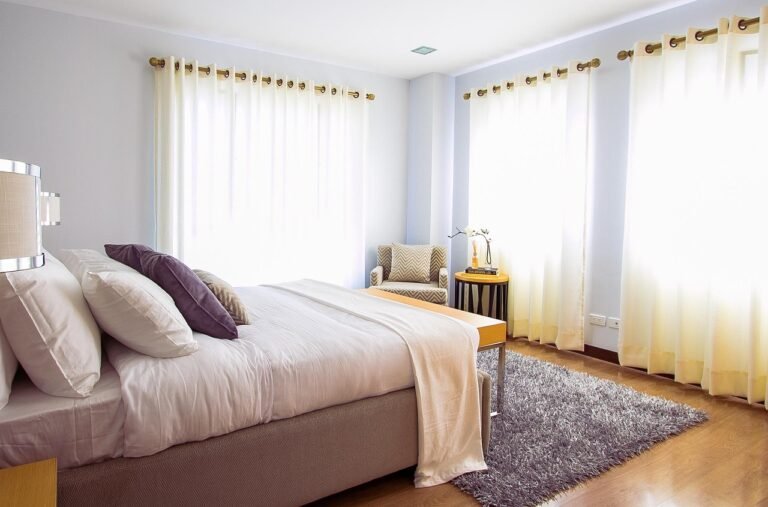

A 24-inch walkway around the bed helps you match the mattress and frame before choosing color or texture. Keep side drops near 6 to 10 inches, limit loft, and select layers that leave visible floor around the bed rather than making the room feel crowded.
You’ll find practical guidance on proportions, duvet covers, comforters, quilts, fabrics, color, pillow counts, and storage for compact bedrooms where comfort still matters.
Measure the Bed Footprint and Walking Clearance
A long comforter can cover the narrow floor strip that makes a compact room feel usable. Record your mattress width and length, frame width, mattress height, and clear paths beside the bed. Your frame, not the mattress label, sets the true footprint.
Walking Clearance Sets the Side Drop
Visible flooring helps you move between the bed, closet, dresser, and door without fabric catching underfoot. A 6- to 10-inch drop from the mattress top suits compact rooms with narrow paths. Your bedding should stop above the floor rather than pool against it.
A queen bed with 18 inches between its rail and a dresser needs a tailored quilt or coverlet. A 14-inch drop leaves little usable path after fabric shifts overnight. Shorter coverage keeps your route open and makes nearby furniture feel less crowded.
- Measure mattress height Include a topper so your fitted sheet grips the full depth.
- Mark frame edges Include side rails, footboards, and upholstered wings that widen the bed.
- Open nearby drawers Check each drawer before selecting a long drop or bed skirt.
- Trace walking paths Leave a usable route from your bed to the door, closet, and dresser.
- Pull storage bins Slide under-bed bins fully outward, especially beneath storage beds.
Room Balance Depends on Seven Design Rules
Clear paths set the room’s basic order, and the rest of the furnishings need the same restraint. Keep visual weight low, repeat a limited palette, size furniture to the room, limit competing patterns, layer lighting, and place daily storage within reach. Your bedding should reinforce those choices rather than work against them.
| Room check | What it protects | Bedding response |
|---|---|---|
| Side walkway | Easy movement | Choose a short, clean drop |
| Under-bed bins | Daily storage access | Skip a dragging skirt |
| Dark corner | Visual depth | Keep the palette tonal |
| Low ceiling | Open sight lines | Limit tall pillow stacks |
A low ceiling benefits from a flatter bed profile because tall pillows pull attention toward the upper wall. Dark corners benefit from close bedding tones because sharp contrast stops the eye at the mattress edge. Your room feels calmer once each layer has a clear visual role.
Match Bedding Size to the Frame Instead of Upsizing
Clearance measurements reveal why a larger label does not always look richer. A king comforter on a queen bed adds width, loft, and loose fabric along both sides. Your bed should look settled, not buried beneath excess material.
Fitted Sheets Need the Right Pocket Depth
Measure from the mattress base to its top surface, including any foam topper. A 12-inch mattress with a 3-inch topper needs a fitted sheet deep enough to wrap beneath both sides. Loose corners make your bed look rumpled before the day starts.
Sheet labels vary, so inspect the stated pocket range rather than relying on labels such as deep pocket. The Company Store, Brooklinen, and IKEA list differing depth ranges across cotton percale sets. Your tape measure settles that detail faster than a product photo.
Construction Changes Visual Bulk
| Bedding type | Visual weight | Compact-room role |
|---|---|---|
| Low-loft duvet insert | Medium | Flexible warmth inside a washable duvet cover |
| Quilt | Low to medium | Neat shape for warm sleepers |
| Coverlet | Low | Tailored finish with a short drop |
| High-loft comforter | High | Suited to cold rooms with broad clearances |
| Bed skirt | Medium to high | Less practical around frequently used storage |
A quilt has stitched fill and lies flatter than a puffy duvet insert. A coverlet is thinner still, with little or no internal fill. Your pick between them rests on nighttime warmth and how much of the bed frame you want visible.
King-size comforters work on queen beds only where broad space surrounds the frame and the foot area stays clear. In a 9-by-10-foot bedroom, mattress-size bedding is the safer starting point. What size bedding is best for a small room depends on the frame and clearance, not room dimensions alone.
A low-loft duvet can suit your room where temperatures change between seasons because the duvet cover takes the visual lead. A thick comforter creates a single bulky form that reaches farther from the mattress. Your top layer should fit your climate without hiding the usable floor you measured.
Once bulk stays within the frame, restrained contrast helps the bed recede rather than dominate the room.
Use Color and Pattern to Keep the Bed Visually Quiet
After the bed fits the room, color decides how forcefully it moves forward in view. Light, low-contrast bedding lets your eye move across the mattress without stopping at a hard border. Your bed still anchors the room, yet it stops acting like a visual wall.
Close Tones Extend the Room
Soft white, warm ivory, pale gray, muted blue, and washed sand can make a compact room feel more open. A warm ivory quilt beside beige walls quiets the boundary between bed and wall. Your neutral color palette works through related undertones rather than blank surfaces.
White is not mandatory. Dark walls can look settled with monochromatic bedding in charcoal, deep olive, or tobacco brown, especially in rooms with limited daylight. Your sheets, coverlet, and walls need close tonal steps rather than hard black-and-white contrast.
Dark or earth-toned bedding also suits homes with pets because clay, mushroom, faded sage, and oatmeal hide daily marks better than bright white. A deep olive coverlet can work beside olive-gray walls without visually shrinking the bed zone. Your accent can stay small: one rust lumbar pillow or a folded throw.
Small Patterns Keep the Bed From Taking Over
Large florals, giant checks, and bold graphic prints can take over the little wall and floor space around a mattress. Choose a solid, fine grid, narrow stripe, or small repeating motif instead. Your pattern should read up close without becoming the room’s largest visual statement.
Vertical stripes on a duvet cover pull attention upward in a room with a low ceiling. Horizontal stripes widen the bed visually, which can make a narrow room feel tighter. Your fabric direction changes perceived proportions even though the mattress itself stays the same size.
Keep strong contrast to one small piece. A dark lumbar pillow reads as an accent, while a dark comforter can absorb the room’s main visual field.
Choose Fabric and Fill That Add Warmth Without Mass
Color settles the visual side of the bed, while heat retention shapes whether it feels comfortable at 2 a.m. Small bedrooms can hold warmth, especially behind closed doors with limited airflow. Your bedding should keep you comfortable without forming a thick mound of fill.
Breathable Fibers Reduce Extra Layers
Cotton comes in crisp, smooth, brushed, and jersey finishes. Linen releases heat well and brings a relaxed surface with visible natural creasing. Your fabric should suit both your climate and your tolerance for texture.
Percale uses a plain weave that feels crisp and airy. Sateen has a smoother surface and warmer-looking sheen, even at the same color depth. Choose percale for a cool, tidy appearance; choose sateen where your preference leans toward softness and fewer visible wrinkles.
Thread count alone does not describe sheet quality. Fiber length, yarn quality, weave, finish, seam strength, and wash performance tell you more about wear over repeated laundry cycles. A 300-thread-count long-staple cotton percale sheet can outlast a dense sheet with inflated numbers.
Texture Adds Shadow and Visual Weight
A pale waffle blanket still throws deep shadows across the bed. Matelassé adds raised stitching, velvet absorbs light, and chunky knits build a thick edge at the foot. Your room can carry one tactile layer, but several textured pieces make the bed read larger than its dimensions.
Linen has a relaxed look but can appear rumpled after sleep. Percale looks flatter and sharper, while sateen gives a smoother finish with mild sheen. Your preference should account for the bed’s daytime appearance as well as how the fabric feels overnight.
When one comfortable cover does enough work, fewer finishing pieces are needed to make the bed feel finished.
Skip dense synthetic bedding in a warm room unless the care label and fill details describe a breathable construction. Heat buildup leads to kicked-off layers, which leaves the bed looking less orderly by morning.
Limit Layers and Pillows to Preserve the Mattress Line
Once your fabric and fill match nighttime temperature, the made bed should take less than two minutes to reset. Start with a fitted sheet, add a flat sheet only where it suits your routine, then use a lightweight blanket and one main top layer. Your bed gains warmth in stages rather than carrying every season at once.
Each Layer Needs a Clear Job
- Fitted sheet Choose a snug pocket depth so the corners stay anchored overnight.
- Flat sheet Keep this layer where its feel and laundry routine suit your habits.
- Light blanket Pick cotton or thin wool for adjustable warmth without a tall profile.
- Main cover Select one duvet, comforter, quilt, or coverlet as the visible finish.
- Foot throw Fold it into a narrow band and remove it before sleep.
Seasonal warmth belongs in a closet or under-bed bin rather than on the mattress year-round. A thin wool blanket can sit beneath a quilt during cooler months, then move off the bed as temperatures rise. Your layers stay useful because each piece has a specific job.
Pillow Counts Keep the Headboard Visible
A twin looks balanced with one sleeping pillow and one accent pillow. A full or queen suits two sleeping pillows plus one lumbar. Your king can hold four sleeping pillows and one long lumbar, though a narrow room benefits from skipping bulky euro shams.
For a queen-bed setup, place two standard sleeping pillows flat, set a 14-by-30-inch lumbar in front, and fold one throw across the lower third. That arrangement leaves the headboard visible and avoids a cushion wall. Your extras turn into nightly clutter once they need a chair or floor landing spot.
Items moved aside each night also need easy laundering and a sensible place to live.
| Bed size | Sleeping pillows | Accent layer |
|---|---|---|
| Twin | 1 | 1 accent pillow |
| Full | 2 | 1 lumbar pillow |
| Queen | 2 | 1 lumbar pillow |
| King | 4 | 1 long lumbar pillow |
Keep Bedding Washable and Storage-Smart
Extra pillows and seasonal layers need a place to live, which makes storage part of the bedding decision. A small closet cannot hold three full seasonal sets without crowding clothing. Your setup should earn each shelf, drawer, and under-bed bin it occupies.
Fewer Pieces Leave More Storage Room
An all-season insert inside a removable duvet cover handles temperature shifts without requiring several bulky comforters. The cover goes into the wash more easily than a filled comforter, and a different cover changes the room’s look without replacing the insert. Your linen storage stays lighter.
A reversible quilt gives your bed two restrained color directions in one piece. Keep one backup sheet set rather than a tower of unopened packages unless laundry access is unreliable. Your storage beds work better where the top layer does not block drawers or bins.
Five Checks Settle the Final Purchase
- Fit check Confirm mattress dimensions, pocket depth, frame width, and side drop before bringing bedding home.
- Weight check View the made bed from the doorway and remove layers that hide visible floor.
- Warmth check Match loft and fiber to your sleeping temperature rather than winter display styling.
- Care check Read wash directions, stitching details, and fill-retention instructions before giving an item storage space.
- Storage check Leave bins, drawers, and closet shelves reachable after the bed is made.
OEKO-TEX Standard 100 screens finished textiles for a list of harmful substances. The Global Organic Textile Standard addresses fiber processing and social criteria for qualifying textile goods. Your hands, laundry routine, and room dimensions still decide whether a bedding set belongs in your home.
Final Thoughts on a Balanced Small Bedroom
The strongest small-bedroom bed is not the sparsest bed. It respects the walkway, keeps colors close to the room, and gets warmth from selective layers rather than excess fill. Your bedding leaves floor, drawers, and visual space available, so the room feels calmer without sacrificing sleep.
How to make a small bedroom look bigger with bedding starts with the measurements beneath the fabric. A short drop, moderate loft, controlled pillow count, and close color range can make your bed feel proportionate to the space around it. Your room does not need bare bedding; it needs bedding with a clear purpose.
FAQ
How do you choose bedding that does not overwhelm a small bedroom?
Choose bedding that matches your mattress and frame, then keep the side drop near 6 to 10 inches where walking clearance is tight. Your bed looks less bulky with a low-loft duvet, quilt, or coverlet and no excess fabric covering the floor.
What color bedding makes a small bedroom look bigger?
Soft white, warm ivory, pale gray, muted blue, and close tonal neutrals make a compact room feel more open because the bed creates less contrast with surrounding surfaces. Your strongest result comes from repeating related wall, rug, and bedding tones rather than placing a dark comforter against pale walls.
Should bedding be light or dark in a small room?
Light bedding works well where you want the bed to recede and floor space to feel more visible. Dark bedding also works with dark walls through a monochromatic scheme, where your sheets, coverlet, and wall color stay within a narrow tonal range instead of forming sharp boundaries.
Should you use a duvet, comforter, quilt, or coverlet in a small room?
A low-loft duvet gives you flexible warmth and a washable duvet cover. A quilt lies flatter, while a coverlet gives your bed the least visual bulk and shortest tailored drop. Your comforter works better in cold rooms with broad walking clearance around the frame.
What size comforter should I use for a small bedroom?
Use a comforter made for your mattress size, then judge its side drop against the bed frame and walkway. Your queen bed does not need a king comforter unless wide clearances allow a deliberate, tailored overhang that does not cover drawers, storage bins, or walking space.
Can a king-size comforter work on a queen bed in a small room?
Broad clear floor space on both sides of the frame can make an oversized comforter workable on a queen bed. In a tight room, extra width hides flooring and can block drawer access. Your queen bed benefits more from a mattress-size quilt, coverlet, or low-loft comforter.