

Most pillows feel fine for a night or two, then your neck quietly starts paying the price. A contoured pillow solves that by giving your head and neck a deliberate shape to rest in, instead of letting them sink wherever the foam wants. The picks below cover side, back, and stomach sleepers, with different heights, materials, and cooling touches so you can match the pillow to your real sleep style.
The Choices Worth Comparing

Ylekto Cervical Neck Pillow Contour Memory Foam (Grey)
Ylekto Cervical Neck Pillow Contour Memory Foam

LOFE Stomach Sleeper Pillow Ultra Slim Memory Foam

Tujami Cervical Neck Pillow Contour Memory Foam

Tujami Cervical Neck Pillow Orthopedic Contour Memory Foam

NOFFA Cervical Neck Pillow Contour Memory Foam

Releep Cervical Neck Pillow Adjustable Contour Memory Foam
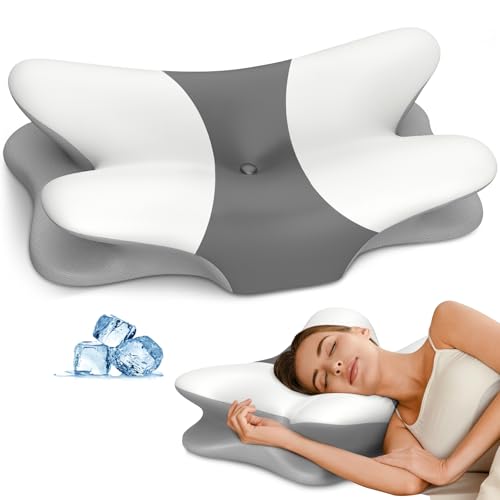
Besyodo Cervical Pillow Contour Memory Foam (White & Grey)
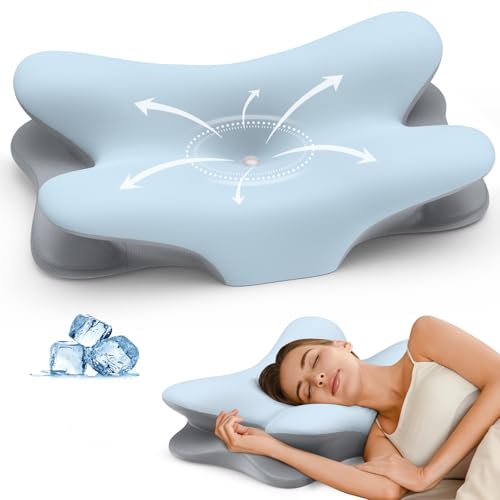
Besyodo Cervical Neck Pillow Contour Memory Foam (Blue)
The Details Behind The Selections
The Ylekto cervical pillow leans into a simple but useful idea: one pillow, two heights. The loft (the height a pillow lifts your head) measures roughly 5.5 inches on the higher side and 4.1 inches on the lower side, so you flip it depending on whether you sleep on your side or your back. The contour cradles the head while the raised edge supports the neck curve, which matters because a flat pillow often lets the chin tip up and the cervical spine (the stack of small bones in your neck) flatten out overnight.
For shoppers who wake up stiff but don’t want to gamble on a strange shape, this is a low-fuss starting point. You may find the higher side too tall at first, so give it a few nights before deciding which face actually fits you.
The Value In It
- Two built-in heights let you test side and back support with one pillow
- Contoured memory foam holds its shape through the night rather than collapsing
- Raised side edges keep your head from rolling off the support zone
- Works for side, back, and lighter stomach sleepers without a major swap
Things To Consider
- Memory foam can sleep warm in summer, so a cooling pillowcase helps
- The taller side may feel firm for petite frames
Who It Suits Best
Side and back sleepers who want a single pillow they can flip instead of buying two to compare.
Where Another Pick Suits Better
Stomach sleepers will get a better fit from the LOFE Stomach Sleeper Pillow, which is built specifically for low, face-down rest.
Where the first Ylekto relies on a simple two-height flip, this sibling uses a butterfly silhouette with a hollow center that your head sinks into. The cavity takes pressure off the crown of your head while the wings support the neck on either side, and the design carries a US patent. Compared to the Ylekto model above, this one feels more deliberately engineered for people whose main complaint is neck alignment rather than general loft.
If you sleep on your side with one arm tucked under the pillow, the side wing gives that arm a soft place to land instead of pushing your shoulder up. For most neck-pain sufferers, that’s the part that wins them over.
Bright Spots
- Hollow center reduces pressure on the top of the head
- Wing shape supports the neck without forcing one fixed sleep position
- Patent-backed design signals more than a generic contour
Worth Noting
- Wing width can feel unusual for stomach sleepers who flip often
- Foam may off-gas (release a mild chemical smell) for the first day or two out of the package
Built With In Mind
Side and back sleepers dealing with neck tension who want a contoured shape that doesn’t force a single position.
Not Your Match When
Shoppers who like to tweak their pillow’s height night to night should look at the Releep, which has a removable middle layer for that exact reason.
Stomach sleeping needs the opposite of a tall pillow, and the LOFE delivers exactly that: a low, flat profile that keeps your neck from cranking upward. The big twist is a removable cooling gel layer tucked into an inner pocket. You add it for hot summer nights and pull it out for cooler months, which is a small detail that ends up mattering more than you’d think.
The memory foam carries a CA Prop 65 certification, which means it has been screened for a list of chemicals California requires companies to warn about. Two machine-washable covers ship in the box, including a breathable mesh option, so cleanup stays simple.
A Strong Showing
- Low profile suits stomach sleepers who can’t handle loft
- Removable gel pad lets you adjust the temperature by season
- Two included covers make laundry rotation painless
- CA Prop 65 certified foam adds a layer of material transparency
Trade Offs
- Too flat for side sleepers with broader shoulders
- Cooling gel layer adds a slight firmness when installed
Key Specs
Made For
Stomach and back sleepers who run hot and want a slim pillow with adjustable cooling.
Look Elsewhere When
Side sleepers need a taller contour like the Tujami Orthopedic Contour Memory Foam, which gives the shoulder room to fill the gap.
The Tujami uses an angled hollow surface, tilted at roughly 15 degrees, to settle your head into a neutral position rather than tipping it back. A butterfly outline spreads pressure across both sides of the neck, which helps if you tend to wake up sore on one side only. There’s also an armrest zone along the bottom edge, a useful touch if you sleep on your side with your arm tucked under the pillow.
For most households, this is a comfortable middle-of-the-road option. The shape looks dramatic in photos, but on the bed it just feels stable and level.
Well-Handled Touches
- 15-degree angled hollow encourages a neutral head position
- Butterfly wings distribute pressure across both sides of the neck
- Armrest zone eases shoulder strain for side sleepers
- Works across side, back, and lighter stomach sleeping
Points To Keep In Mind
- Cooling performance depends heavily on the cover you pair with it
- Distinct shape takes a few nights to feel natural
Right Fit For
Side and back sleepers who want a stable, neutral cradle without committing to a fixed height.
Skip It When
Anyone who wants a fully customizable loft should consider the Releep Adjustable Contour Pillow instead, since its middle layer comes out.
This second Tujami shares the butterfly look with the one above, but leans harder into side-sleeper ergonomics. The armrest zone runs deeper along the bottom edge, which gives the shoulder more room to drop in instead of pushing it up toward the ear. Pressure spreads through the wider wings rather than focusing on the neck base, a small shift that matters if you wake up with a sore trapezius (the muscle running from neck to shoulder).
It uses a cooling cover to help with the warmth that memory foam tends to trap, though the cover is the main thing doing the temperature work, not the foam itself.
Everyday Wins
- Deep armrest zone gives shoulders space to settle
- Butterfly shape spreads pressure instead of concentrating it
- Cooling cover helps offset memory foam warmth
- Good match for side sleepers who switch shoulders during the night
Honest Caveats
- Stomach sleepers will likely find the wings too obtrusive
- Firmness runs a bit higher than the first Tujami in this list
Feature Snapshot
Best Suited To
Side sleepers with broader shoulders who feel jammed up by standard contour shapes.
Swap It Out When
You mostly sleep face-down, where the LOFE Stomach Sleeper Pillow handles the low profile properly.
The NOFFA’s main trick is that it ships in three size options rather than one, which makes it a smart pick for households where two people want the same pillow but have different builds. The standard size measures 23.6 by 15.7 inches with two loft heights around 3.1 and 3.9 inches, and a medium-soft firmness that lands between plush and structured. A removable cooling cover handles the sweat factor.
For couples or guest rooms, having that size choice cuts down on the guessing game that usually comes with online pillow orders.
The Upside
- Three size options cover a wider range of body types
- Two loft heights add another layer of personalization
- Medium-soft feel appeals to people who want cushion without sink
- Removable cover makes washing straightforward
Possible Compromises
- Loft tops out lower than taller contour pillows on this list
- Medium-soft feel may not satisfy shoppers who want a very firm surface
Who Will Love This
Multi-sleeper households who need the same pillow in different sizes for different bodies.
Reach For A Different Pick When
You want a single pillow with adjustable loft, which is what the Releep Cervical Neck Pillow is designed for.
The Releep is the only pillow in this roundup that lets you change its height after you buy it. The base configuration runs 4.7 inches on the high side and 3.9 inches on the low side, and there’s a removable middle layer that drops the loft down to 3.7 and 3.5 inches if even the lowest setting feels too tall. Wave-shaped edges round the contour so the neck doesn’t meet a hard line.
This is the pillow to grab if you’ve bought two pillows in the past and returned both because the height was off. You may end up keeping the middle layer out long-term, but having the option saves a return trip.
Practical Pluses
- Removable middle layer lets you dial loft down to 3.5 inches
- Wave edges avoid the hard ridge some contours create
- Queen size fits standard pillowcases without fighting the fabric
- Useful for households where two sleepers share one pillow type
A Few Limitations
- More pieces to keep track of than a single-foam pillow
- Memory foam density runs firm, which takes adjustment
Feature Rundown
Perfect Match For
Height-sensitive sleepers who want to tune their pillow rather than guess and return.
Where A Sibling Pick Shines
Shoppers who want a firmer orthopedic feel with a wider armrest zone will prefer the Tujami Orthopedic Contour Memory Foam.
The first Besyodo on the list uses a US-patented ergonomic curve that wraps around the head and supports the neck’s natural arch, which is the part that often flattens out under a standard pillow. The contoured area targets the cervical spine rather than the skull, so your head rests in the cradle instead of sitting on top of the foam.
The white and grey colorway is a quiet plus for bedrooms with lighter bedding, and the cover removes for washing. For most sleepers, this lands as a versatile everyday contour rather than a specialty shape.
The Good Stuff
- Patented ergonomic curve targets neck arch support
- Head sits in a cradle rather than on top of the foam
- Neutral colorway fits most bedding styles
- Removable cover simplifies cleaning
Less Ideal Details
- Foam may feel firm for shoppers used to down-style pillows
- Shape takes a few nights to feel familiar
Who Should Grab It
Multi-position sleepers who want a contoured shape without specialty features they won’t use.
Consider Something Else When
Hot sleepers who want active cooling should look at the LOFE Stomach Sleeper Pillow with its removable gel layer.
The blue Besyodo focuses on a hollow center that works like a cradle for the top of the head, lifting pressure off the crown while the contour edges handle the neck. Compared to its white-and-grey sibling above, the design feels a touch softer and more inviting if you’ve never used a contour pillow before. The blue color also hides wear over time, which matters for a pillow you’ll use every night for years.
It supports side, back, and stomach sleepers, though stomach sleepers in particular may find the center depth takes a few nights to get used to.
Reasons It Performs
- Hollow center reduces pressure on the top of the head
- Contour edges support the natural neck curve
- Blue cover hides everyday wear and minor stains
- Approachable shape for first-time contour users
What To Weigh
- Center depth can feel unusual for stomach sleepers at first
- Color choice is limited to this one blue option
Spec Overview
The Right Fit
First-time contour shoppers who want a forgiving shape that works across multiple sleep positions.
A Better Fit Elsewhere
Side sleepers needing shoulder room will find a deeper armrest zone on the Tujami Orthopedic Contour Memory Foam.
What Matters Most Before Choosing Contoured Pillows
Match The Loft To Your Sleep Position
Loft, the height the pillow lifts your head, drives whether a contour pillow helps or hurts. Side sleepers usually need 4 to 5.5 inches so the ear sits in line with the shoulder. Back sleepers land closer to 3.5 to 4.5 inches so the chin doesn’t tip forward. Stomach sleepers want the lowest profile possible, often under 3.5 inches, because anything taller cranks the neck backward. Getting this wrong is the fastest way to make a “good” pillow feel wrong, so check the loft range before the brand name.
Foam Density Beats Brand Promises
Memory foam density, measured in pounds per cubic foot, tells you how much support the pillow actually gives. Lower-density foam feels plusher but flattens faster. Higher-density foam holds its shape longer and supports the cervical spine more reliably. If a pillow doesn’t list density, look at the weight, since heavier contour pillows usually contain denser foam. The trade-off is firmness: high density feels firm at first and softens after a week of use.
Cooling Is Mostly About The Cover
Most memory foam traps heat, and the foam itself rarely does much to fix that. The cover is where cooling happens, whether through a mesh weave, a phase-change fabric (a material that absorbs and releases heat to stabilize temperature), or a removable gel insert. If you run hot, prioritize the cover system over any “cooling foam” claim. The LOFE in this list is the one exception, with a gel layer that actually sits inside the pillow rather than just on the surface.
Adjustability Saves Returns
Contour pillows are tricky to buy online because your body’s exact dimensions matter. Pillows with removable layers or dual-height flips let you test two configurations in one purchase. The Releep in this roundup is the clearest example, with a middle layer that drops the loft if the default height feels off. For first-time contour shoppers, adjustability tends to be worth more than a slightly lower price.
Common Slip Ups When Shopping For Contoured Pillows
Picking Loft By Brand Instead Of Position
Many shoppers reach for a “firm” or “soft” pillow without thinking about their sleep position, and that’s how a pillow ends up too tall for a stomach sleeper or too flat for a broad-shouldered side sleeper. Position drives loft, not brand reputation. Measure the pillow’s height against your shoulder width and neck length before you commit.
Ignoring Cover Care
Contour pillows need their covers washed more often than standard pillows because the shape traps body heat and oils in the recessed center. A non-removable cover is a long-term frustration. Always check that the cover unzips and the inner foam stays protected during washing.
Where The Extra Money Goes In Premium Contour Pillows
Patented Shapes And Engineered Curves
The price jump on higher-end contour pillows usually comes from patented designs rather than better foam. A patented butterfly or hollow-center shape is more expensive to design and test, and the brand passes that cost along. The trade-off is that the shape often fits a wider range of body types than a generic contour.
Adjustable Layer Systems
Pillows with removable middle layers or modular heights cost more because they ship with multiple foam pieces and a custom cover system. You pay for the ability to tune the pillow, which matters if you’ve returned contour pillows in the past. Once you find your setting, the modular design often outlasts a single-foam pillow because you can adjust it as your body or sleep style changes.
Frequently Asked Questions
How long does a contoured memory foam pillow typically last?
Most contour memory foam pillows hold their supportive shape for two to four years of nightly use, depending on density and care. Higher-density foam usually outlasts lower-density foam by a year or more, and using a washable cover helps the foam stay clean and intact longer.
Can a contoured pillow help with neck pain?
A contoured pillow can help when the pain comes from poor neck alignment during sleep, since the shape keeps the cervical spine in a neutral position. It works less well for pain caused by injuries, arthritis, or structural issues, which usually need a different approach beyond a pillow swap.
Are contour pillows good for side sleepers?
Contour pillows work well for side sleepers as long as the loft matches the shoulder width. Side sleepers with broader shoulders usually need 4.5 to 5.5 inches of loft, while smaller-framed side sleepers do fine closer to 4 inches. Too low and the head drops, too high and the neck angles awkwardly.
Do contour pillows need a break-in period?
Most memory foam contour pillows feel firm for the first week or two as the foam adjusts to your head and neck. Loft may also feel slightly higher than expected at first, then settle into its real height after several nights. Give a new contour pillow at least a week before deciding whether the height works.
How do I clean a contoured memory foam pillow?
The foam core should not go in a washing machine. Instead, remove the outer cover and wash that according to its tag, then spot-clean the foam with a mild detergent and let it air dry completely. A removable, washable cover makes the routine much easier, which is why cover quality matters when you pick a pillow.
Bottom Line
The right contoured pillow comes down to your sleep position and how adjustable you want the loft to be. Side and back sleepers usually land on the Ylekto or Tujami options for their tested shapes, while stomach sleepers get a real fit from the LOFE. Anyone unsure of their ideal height should start with the Releep’s removable layer system and tune from there. A few nights on a well-matched contour pillow often changes how the rest of the day feels, more than most people expect.